Qivronel
Nexus Series
Nexus Series
Couldn't load pickup availability
1. Problem Statement
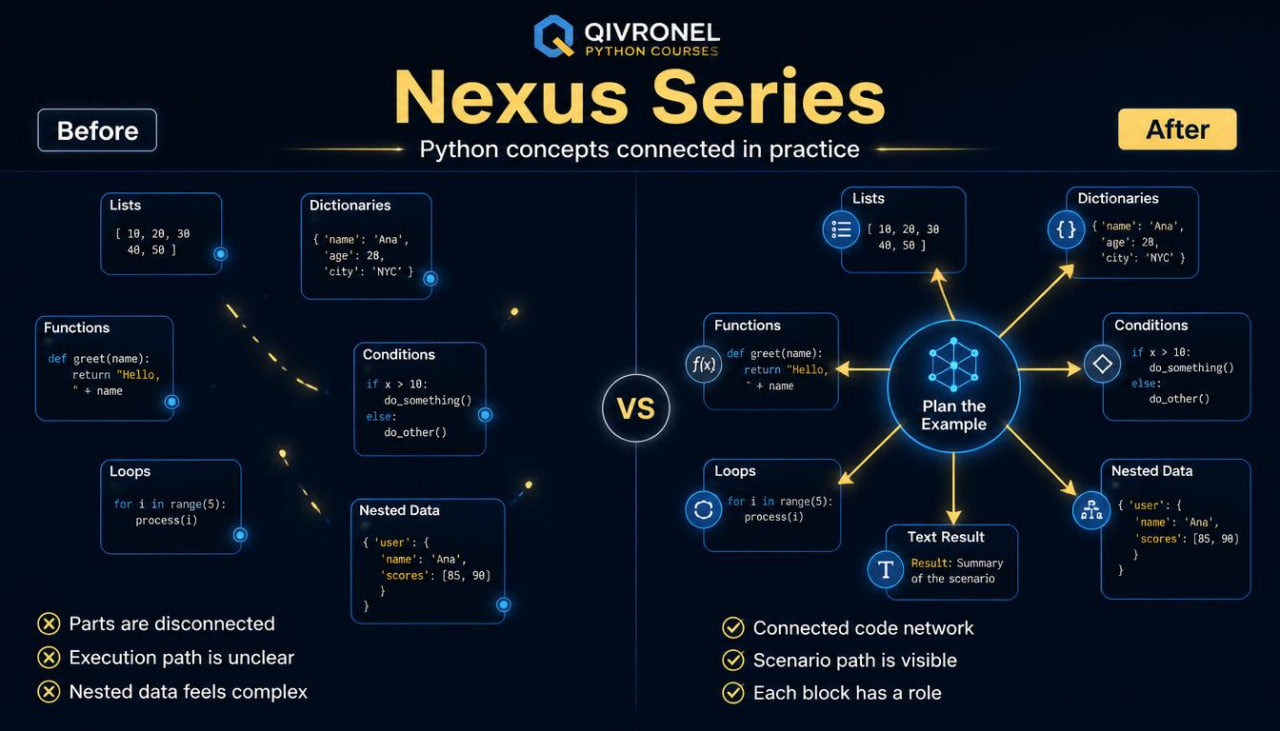
At a later stage of learning Python, the learner often knows many separate topics but may get lost when they appear together in a longer example. A list can be passed into a function, a function can return a dictionary, a loop can change intermediate values, and a condition can affect the final result. With this number of connections, it can be hard to see right away which code part handles data, which one handles checking, and which one forms the summary. The learner may also need exercises where the task is not only to complete one line, but to explain the full execution path of the example. Nexus Series is created for the stage where Python needs to be studied as a system of connected blocks.
2. Solution
Nexus Series presents Python through learning scenarios where several topics work together. The materials show how to build an example from data preparation to the final result without mixing all actions into one large fragment. The learner works with functions, lists, dictionaries, conditions, loops, text results, and mistakes in one learning logic. Each module includes an explanation, example, review, practice task, self-check questions, and a short recap. This format helps the learner see topic connections and work with longer Python examples in a more careful way.
3. What’s Inside
Nexus Series includes a wide series of learning modules built around connections between different parts of Python code. If Luma Series helped learners work with longer examples, Nexus Series adds more attention to structure, logic, execution order, and explanation of interaction between blocks.
The first module reviews the full earlier base. The learner repeats variables, data types, conditions, loops, lists, dictionaries, functions, and text operations not separately, but through connected examples. In every fragment, the learner needs to identify where data is created, where it changes, where it is checked, and where the result is formed. This review helps prepare for longer scenarios without a sharp jump in difficulty.
The second module focuses on planning a learning example. The learner sees how a task can be divided into several parts before code is written: data, processing, checking, summary, and result output. The materials explain why it is useful to understand the shape of the data first, and only then write functions and conditions. In the exercises, the learner reads a task description and chooses which Python structures fit the learning solution.
The third module covers lists as a base for scenarios. The learner works with sets of numbers, text values, learning topics, and short labels. Tasks show how to move through a list, select part of the values, create a new list, count items, or pass a list into a function. Special attention is given to how the list changes during code execution.
The fourth module moves to dictionaries in connected examples. The learner works with structures where keys describe names, categories, states, exercise counts, or short notes. The materials show how a dictionary can store the summary of loop work, how a function can update values, and how key checks affect the result. In tasks, the learner needs not only to write code, but also to explain the role of each key.
The fifth module focuses on functions as connection points. The learner sees how one function can prepare data, another can process a list, a third can create a dictionary, and a fourth can form a text result. Explanations help avoid confusion between parameters, passed values, local variables, and returned results. Practice tasks ask the learner to complete functions, change parameters, and describe how one function passes a result to another scenario part.
The sixth module combines conditions with functions. The learner works with examples where a function checks data, chooses the needed path, and returns different results depending on the condition. The materials show how to place a check inside a function, when to move a check into a separate part, and how to make a condition readable. Tasks ask the learner to change the checking rule and explain how it affects the whole scenario.
The seventh module focuses on loops in longer scenarios. The learner analyzes how a loop moves through data, which values are collected, where an intermediate result appears, and how it is used later. Examples include counting, filtering, creating new structures, and preparing data for functions. In the exercises, the learner traces loop execution step by step and writes how the result changes.
The eighth module covers text results. The learner studies how to create short messages, summary lines, descriptions for learning data, and text reports based on lists or dictionaries. The materials show how text operations can finish a scenario and make the result readable. Tasks ask the learner to form several summary lines based on processed data.
The ninth module focuses on nested structures. The learner works with examples where a list contains dictionaries or a dictionary contains a list of values. The materials explain how to read such structures step by step: first the outer level, then the inner level, then the needed value. Exercises ask the learner to find a specific item, change a value, move through a nested structure, and form a short result.
The tenth module includes scenarios with several functions. The learner receives tasks where they need to prepare data, process it, check conditions, form a result dictionary, and create a text summary. The materials show how to divide a scenario into small functions so each one handles a separate action. This helps keep the logic readable in a longer example.
A separate large block focuses on mistakes in connected code. It covers situations where a mistake appears because of an incorrect connection between parts: a function receives the wrong data type, a dictionary does not have the needed key, a list changes in an unexpected place, a condition is placed in the wrong block, a result is not returned from a function, or a text summary is formed from the wrong value. Each example has an explanation, cause review, and correction task.
Nexus Series also includes a self-check block. It contains questions not only about syntax, but also about logic: where the scenario begins, which data is used, which function is called first, what changes in the loop, which result is returned, and why a condition affects this exact part of the code. This format helps train careful reading.
The final part of the tier includes several large learning scenarios. They combine lists, dictionaries, functions, conditions, loops, text operations, and mistake review. The learner needs not only to complete the task, but also to describe the structure: which blocks are present in the scenario, how they are connected, where data is passed, and how the final result is formed. This makes Nexus Series a tier for deeper work with connections in Python.
4. Who Is This For?
Nexus Series is for learners who already know the main Python topics and are ready to work with longer learning scenarios. Before this tier, it is helpful to understand variables, conditions, loops, lists, dictionaries, functions, nested structures at a basic level, and text operations.
This tier is useful for learners who want to see more clearly how separate code parts connect with each other. If the learner can complete short exercises but gets lost in examples with several functions and data structures, Nexus Series gives steady practice for that stage.
The tier also fits learners who want to explain code in words. The materials include many tasks where the learner describes the path of data, the role of functions, condition work, and loop results in personal wording.
5. What You’ll Learn
- How to review earlier topics through connected scenarios.
- How to plan a learning Python example before writing code.
- How to identify which data a task needs.
- How to work with lists in longer examples.
- How to use dictionaries for storing summaries.
- How to pass lists and dictionaries into functions.
- How to divide a scenario into several functions.
- How to combine functions with conditions.
- How to trace value changes in loops.
- How to create text results based on data.
- How to read nested structures step by step.
- How to find mistakes between different code parts.
- How to explain scenario execution order.
- How to describe the role of each function in an example.
- How to work with larger Qivronel learning tasks.
6. Order Review Terms
For Nexus Series, there is a 30-day period for contacting support about order questions, according to the store rules. If the material format or tier content does not match expectations, the buyer can write to support during this period. Messages are reviewed based on the terms for digital learning materials and the specific order. Before choosing this tier, the learner can review Free Kit to see the Qivronel explanation style through the introductory set. Nexus Series is created for learning through connected scenarios, examples, exercises, self-check tasks, and careful code structure review.
Self-paced learning overview
- 💾 Digital file available after purchase
- 🗂️ Long-term availability
- 🔐 Secure checkout
- 🗓️ Content updated in 2026
What format are the course materials provided in?
What format are the course materials provided in?
Qivronel materials are prepared in a digital format for self-paced study. Each tier includes learning blocks, explanations, code examples, practice tasks, and short recap sections. The structure is made so the learner can move through the topics gradually without too many new details at once. The materials are intended for personal study at a comfortable pace. The main focus is clear Python explanation, code logic, and practical topic review.
Is the course suitable for beginners?
Is the course suitable for beginners?
Yes, the starting Qivronel tiers are suitable for learners who are just getting familiar with Python. Topics are presented in stages: from basic ideas to simple examples and small practice tasks. A learner does not need previous preparation to begin with the first tier. Higher tiers add more topics, examples, exercises, and learning scenarios. This allows each learner to choose a tier that matches their current stage and study goal.
How are the tiers different from each other?
How are the tiers different from each other?
The tiers are arranged in growing order by material volume, number of topics, depth of explanation, and practice tasks. Starting tiers introduce Python basics and offer a short learning start. Middle tiers add more structure, examples, exercises, and review. Higher tiers include a wider set of topics, additional learning materials, independent tasks, and more expanded explanations. This lets the learner choose the amount of material that fits their current study stage.
Share