Qivronel
Axis Set
Axis Set
Couldn't load pickup availability
1. Problem Statement
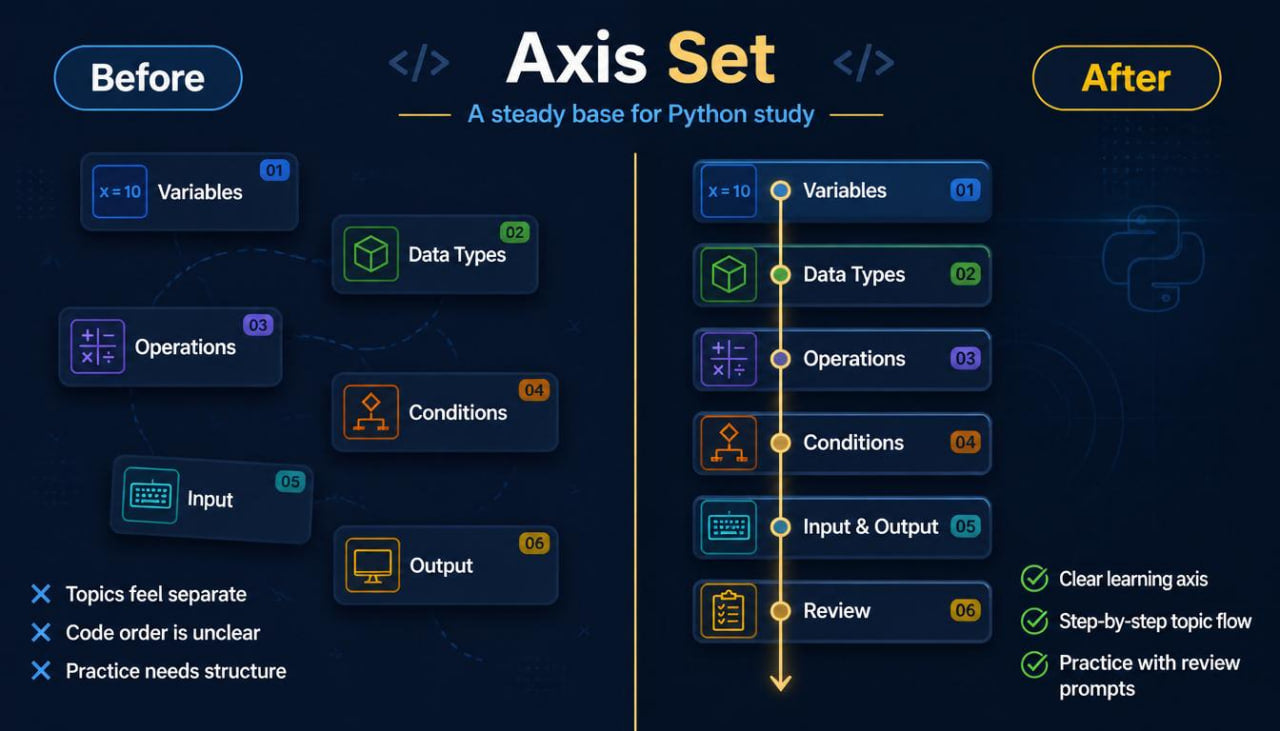
After a short introduction to Python, many learners need a clearer learning axis so they do not jump between topics randomly. Starting concepts may seem understandable on their own, but the challenge appears when variables, data types, operations, conditions, and simple actions need to work together in one example. Without a consistent structure, a learner may remember separate fragments but not see the wider code logic. At the beginning, there is also often not enough practice where the learner can do more than read an explanation: change an example, complete a line, and review personal understanding. Axis Set is created for this exact stage: when the first introduction has happened, but a more organized base is needed for further study.
2. Solution
Axis Set offers an organized starting set of materials where basic Python topics are divided into small learning parts. Each module follows the same format: short opening, explanation, code example, notes for the example, practice task, and recap. This format helps the learner move calmly and see the connection between separate ideas. The learner gradually moves from simple values and variables to conditions, comparisons, input, output, basic calculations, and reading short code fragments. Axis Set works as a first paid step for learners who want more structure than Free Kit but are not ready for a larger learning set yet.
3. What’s Inside
Axis Set includes an expanded starting block for studying Python, with focus on basic code logic, example reading, and first independent practice. If Free Kit shows the Qivronel format, Axis Set gives a fuller learning base.
The first module introduces the role of Python in learning code. It explains that code can be viewed as a sequence of instructions, where each line has its own purpose. The learner sees how simple commands interact, why line order matters, and how a small change can alter the result of an example.
The second module focuses on variables and names. It covers how to create variables, how to give them readable names, and how to store numbers, text, and boolean values. A separate part explains why variable names should be easy to read, how to avoid confusion between similar names, and how to return to an already created value in later code lines.
The third module explains basic data types. The learner works with strings, whole numbers, decimal numbers, and boolean values. The materials show how different types behave during calculations, comparisons, and result output. For example, a number can be added to another number, and text can be joined with other text, but these actions follow different logic.
The fourth module is about simple operations. It explains addition, subtraction, multiplication, division, and basic rules for working with expressions. The materials do more than show operation symbols; they explain how to read an expression, how to understand the order of actions, and how to write short calculations in a readable form.
The fifth module introduces conditions. The learner becomes familiar with the idea of checking: when a condition is true, code follows one route; when it is not, it follows another. Explanations are shown through simple examples: comparing numbers, checking a text value, and making a basic yes-or-no decision. Special attention is given to indentation, because it often creates mistakes at the beginning.
The sixth module focuses on input and output. The learner sees how code can receive a value from a user, store it in a variable, and then show a result. This block explains the difference between a text value and a number, as well as why some entered values need to be changed before calculations.
The seventh module contains first mini tasks. They are built around small scenarios: create variables, perform a calculation, check a condition, and show a short result. The tasks are not overloaded, but they ask the learner to apply several topics together. This matters because combining ideas helps the learner see code structure more clearly.
A separate block in Axis Set focuses on reading code. The learner receives short examples and then answers what each line does. This format develops attention to detail: variables, values, operations, conditions, and results. It is useful for learners who want not only to write lines, but also to understand examples created by others.
The tier also includes short recap sections after each module. They collect key ideas, small reminders, and self-check questions. Recaps can be used as study notes after finishing a topic or before returning to exercises.
Axis Set includes a mini glossary with terms that appear in the starting topics. It explains words such as variable, value, string, integer, float, boolean, condition, input, output, and expression. Each explanation is short and written so the term can be understood through an example, not only through a definition.
The learner also receives a set of review questions. These questions do not judge the learner; they help repeat the material: what a variable is, when a condition is needed, why data type matters, and how to read an example line by line. This makes study more organized and helps the learner notice which topics may need another review.
4. Who Is This For?
Axis Set is for learners who have already reviewed introductory materials or simply want to start with a fuller beginning base. It is a fitting option for those who do not want a large tier right away but need more examples, explanations, and exercises than the free set provides.
This tier is useful for beginners who want to understand Python basics gradually. It does not require previous preparation, but it gives enough material so the learner is not limited to a surface introduction. Axis Set can also fit those who have seen Python before but want to organize basic concepts and practice with small tasks.
The tier is created for self-paced study. The learner can move through modules at a personal rhythm, return to examples, reread recaps, and complete exercises again. Because of this, Axis Set works well as a first anchor before wider Qivronel tiers.
5. What You’ll Learn
- How to read simple Python code line by line.
- How to create variables and give them readable names.
- How to work with text, numbers, and boolean values.
- How to recognize basic data types in examples.
- How to perform simple arithmetic operations.
- How to build short expressions for calculations.
- How to check conditions through comparisons.
- How indentation works in simple conditional structures.
- How to receive entered values and show a result.
- How to combine variables, operations, and conditions in one task.
- How to notice common mistakes in short examples.
- How to use recap sections for topic review.
- How to answer self-check questions after a module.
- How to prepare for wider practical topics in the next tiers.
6. Payment Return Terms
For Axis Set, there is a 30-day period for contacting support about payment return, according to the store rules. If the material format or tier content does not match expectations, the buyer can write to support during this period. Requests are reviewed based on the terms for digital learning materials and the actual order. Before choosing this tier, the learner can review Free Kit to see the Qivronel style through introductory materials. Axis Set is created as a calm first paid step for studying Python through modules, examples, exercises, and review.
Self-paced learning overview
- 💾 Digital file available after purchase
- 🗂️ Long-term availability
- 🔐 Secure checkout
- 🗓️ Content updated in 2026
What format are the course materials provided in?
What format are the course materials provided in?
Qivronel materials are prepared in a digital format for self-paced study. Each tier includes learning blocks, explanations, code examples, practice tasks, and short recap sections. The structure is made so the learner can move through the topics gradually without too many new details at once. The materials are intended for personal study at a comfortable pace. The main focus is clear Python explanation, code logic, and practical topic review.
Is the course suitable for beginners?
Is the course suitable for beginners?
Yes, the starting Qivronel tiers are suitable for learners who are just getting familiar with Python. Topics are presented in stages: from basic ideas to simple examples and small practice tasks. A learner does not need previous preparation to begin with the first tier. Higher tiers add more topics, examples, exercises, and learning scenarios. This allows each learner to choose a tier that matches their current stage and study goal.
How are the tiers different from each other?
How are the tiers different from each other?
The tiers are arranged in growing order by material volume, number of topics, depth of explanation, and practice tasks. Starting tiers introduce Python basics and offer a short learning start. Middle tiers add more structure, examples, exercises, and review. Higher tiers include a wider set of topics, additional learning materials, independent tasks, and more expanded explanations. This lets the learner choose the amount of material that fits their current study stage.
Share